Description
Artist/Maker: Kostas Kampouropoulos (1939-2018)
Object/Materials and Techniques: Oil on Canvas
Date: Painted between 2007-2016
Dimensions: H. 100 cm. x W. 120 cm.
Art style: Romantic Elements / Expressionistic Structures / Abstract Art
Current Location: Private collection
Curator’s Note: 𝐓𝐡𝐞 𝐀𝐧𝐧𝐮𝐧𝐜𝐢𝐚𝐭𝐢𝐨𝐧: 𝐀 𝐇𝐞𝐥𝐥𝐞𝐧𝐢𝐜 𝐇𝐨𝐦𝐚𝐠𝐞
Konstantinos Kampouropoulos | The Struggle of Hellas series
by Nelly Fili
The Solomic Ideal in Visual Form
This painting stands as a profound homage to the Hellenic War of Independence (1821–1830), an era that remains a foundational milestone for Hellenic citizens. The Revolution, which according to tradition was officially declared on 25 March 1821, coincides with the religious feast of the Annunciation. This chronology is a significant calendar date, celebrated by the modern Hellenic State as a National Day, intertwining the liberation of a nation with the spiritual promise of salvation.
Much like the verses of National Hellene Poet, Dionysios Solomos, whose masterpiece The Free Besieged achieved a height of moral grandeur that transcends time, the works of Konstantinos Kampouropoulos capture this very transcendence. It is truly remarkable how the artist moves beyond the traditional ‘theatricality‘ and rigid structural organisation of the Munich School—so masterfully exemplified by Theodoros Vryzakis’s iconic The Sortie—to instead honour the internal, spiritual victory of the Hellenic soul. With its defining misty atmosphere and ‘floating‘ (aioriseis) forms, his art captures the exact moment the body is broken and the soul takes flight. It is not an image of defeat, but a testament to Resurrection.
Within his Struggle of Hellas series, Konstantinos Kampouropoulos offers a unique, metaphysical window into 1821. While the collection is unified by its historical subject matter, in his most transcendent pieces, he moves away from the realistic brutality of battle; instead, his brushstrokes release the spiritual essence of the Athanatoi (Immortals), using the composition of floating figures in an atmospheric setting to symbolise the unwavering resilience and spiritual freedom of the Hellenes.
The Dual Symbolism of March 25th
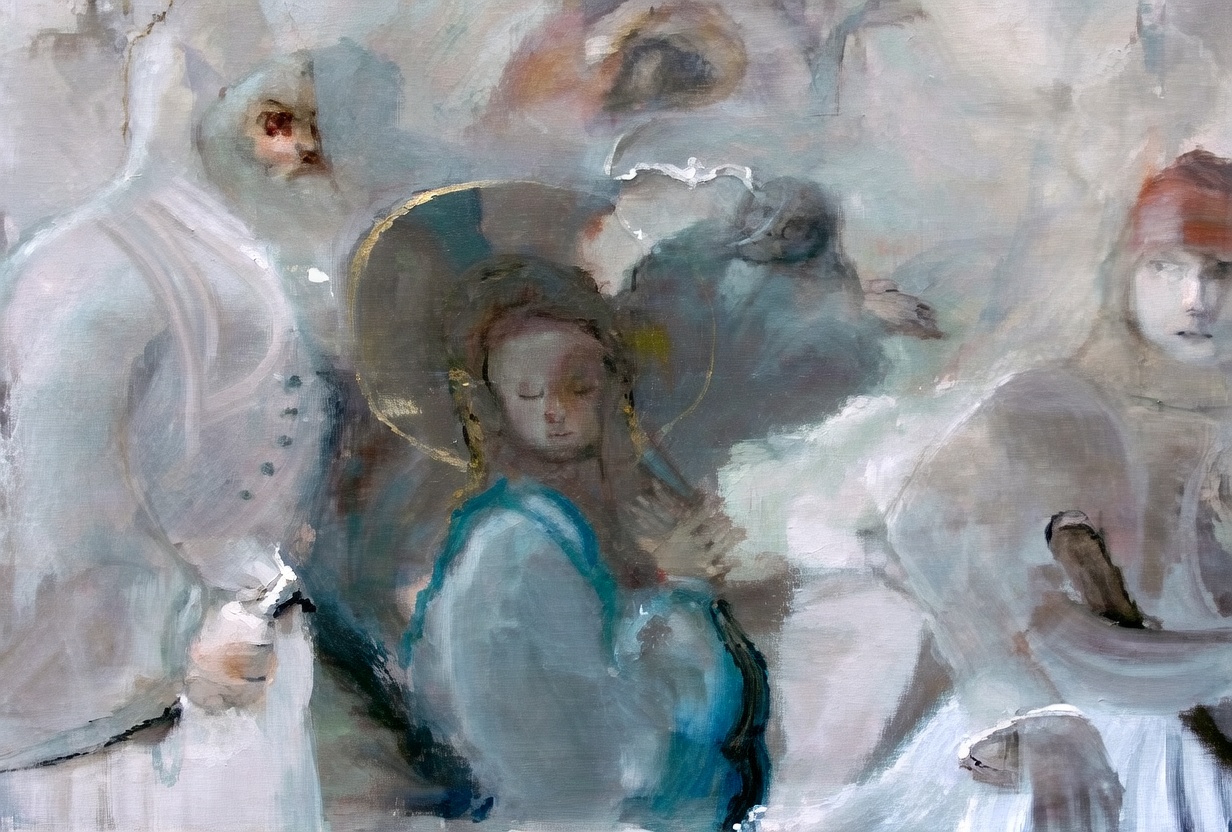
Specifically in The Annunciation (Evangelismos), Konstantinos Kampouropoulos addresses the meaningful dual symbolic character—historical and religious—of this pivotal date. Capitalizing on strong allegory with a powerful accent, he parallels his home country, Hellas, with the Virgin Mary, and the Hellenic patriots with the angels, archangels, and saints of traditional Marian iconography. The painting’s structure is orchestrated through a dynamic tumult of forms that surround and bring into focus the personification of Hellas through the meritorious status of the Virgin.
The Blessed Virgin Mary appearing in a childlike depiction at the heart of the work, is filled with grace with grace and reminiscent of the Immaculate Conception. This youthful portrayal heightens the symbolic potential of the newly established Hellenic State of the 19th century, which, despite its small size, rebelled and gained global recognition. To her left stands the robust figure of an adult fighter, while to the right is a younger patriot—both acting in defense against the conqueror. A pure white dove flies overhead, incorporating the symbol of the Holy Spirit.
Behind the central figures, Konstantinos Kampouropoulos allegorically develops the ‘European Enlightenment’ in a spiral shape—an implicit reference to the decisive intervention of the Great Powers (Great Britain, France, and Russia) of the time in the War of Independence.
The Goya Influence and the Blue Transcendence
Konstantinos Kampouropoulos’s oeuvre evokes the style of the Spanish masters, particularly Francisco Goya, by whom he was greatly influenced. Drawing from Goya’s politically oriented works and his own Goyescas series referring to the struggles of Spain, Konstantinos Kampouropoulos proudly addresses the ‘marks’ of the Struggle of Hellas. Nevertheless, his personal vernacular remains dominant: the lack of outlines and the fluid, dreamy contours lead to a distinctive abstract expression that disciplines the intensity of color.
While white dominates the palette, the painting radiates a pervasive blue, suggesting the ‘heavenly color‘ of the Byzantine/Orthodox tradition. As blue is the colour of the heavens, it suggests a divine atmosphere where every form absorbs light from the central, sacred figure.
‘I chose The Annunciation to pursue other themes on the Hellenic Revolution… I am basically a fairy-tale painter. I am attracted to the incompatibility of the forms and the environment.’ — Konstantinos Kampouropoulos, For the Painting (2013)
A Legacy of National Pride
Today, The Annunciation acts as a catalytic reminder of national pride. It bridges grand narratives—the liberation of a Nation and the spiritual salvation of the world—with the revitalizing outset of Spring. It is a masterful attempt to reveal the simultaneous regeneration of nature and the spirit.
We are honoured to exhibit this powerful tribute to that era by Konstantinos Kampouropoulos, from his ‘Historical’ collection.
We invite you to experience this profound homage to the eternal Hellenic soul!
Bibliographic References:
- Κωνσταντίνος Ι. Καμπουρόπουλος, Για τη Ζωγραφική, Αθήνα, Εκδοτικός Οργανισμός Πάπυρος, 2013, p. 22, 25, 231, pp. 80-81.
- Christopher Montague Woodhouse, Modern Greece: A Short History, London, Faber and Faber, 1968, p. 113.
- John Ash, A Byzantine Journey, London, Random House Incorporated, 1995.
- THE ART BOOK, London, PHAIDON, 1996, p. 194.
- Matthew Craske, Art in Europe 1700-1830, Oxford University Press, 1997, pp. 75-78, p. 156.
Notation:
- Annunciation: The Catholic and Eastern Orthodox celebration of the announcement by the Archangel Gabriel to the Virgin Mary that she would conceive and become the mother of Jesus, making his Incarnation.